Wednesday, May 17, 2006

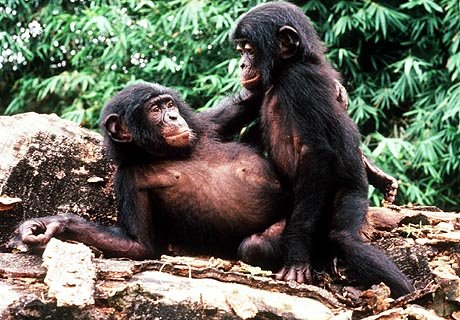
Early humans had sex with chimps

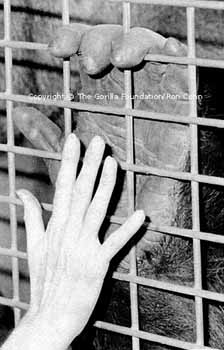
"Our early ancestors interbred with chimpanzees after the two species drew apart millions of years ago, a new paper suggests.

The provocative idea is sketched by US genome experts, who have discovered that hominids and chimps diverged far more recently, and over a much longer timescale, than anyone had thought.

During this time, the authors theorise, the two primates were rather more than kissing cousins: they had sex, swapping genes before making a final separation."

"The ... analysis revealed big surprises, with major implications for human evolution," says Professor Eric Lander, director of the Broad Institute of Harvard University and the Massachusetts Institute of Technology, and co-author of the paper in today's issue of the journal Nature.

Until now, the belief was that humans and chimpanzees shared a common ancestor but went their separate ways around 6.5-7.4 million years ago. "

Genetically, chimpanzees are 98.5% identical to humans.

Looking at DNA

"Exploiting the mountain of data that has come from the human and chimpanzee genome projects, the researchers compared the genetic codes of the two species as they are today.

They believe that the two species made their split no later than 6.3 million years ago and probably less than 5.4 million years ago. In other words, around 1 to 2 million years earlier than the Toumai estimate.

Moreover, speciation of chimp and hominid, the process by which they emerged as separate species, took an extraordinary long time: around four million years in all."

Sex chromososmes

"Previous studies suggest that sex chromosomes are among the most vulnerable of chromosomes when it comes to interbreeding. This is because co-mingling places its genes under swift selective pressure.

Thus something unusual must have happened on the way to speciation: an initial split between human and chimp, followed by interbreeding, whose results show up in progressive younger genes, and then a final separation."

From: News in Science

Wednesday, May 10, 2006

Men's fingers and faces reveal masculinity and attractiveness to women


Both our faces and our fingers have a lot to reveal about ourselves.

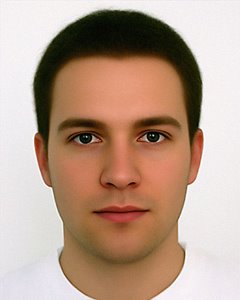
New research suggests that women can spot subtle signs of interest in children in a man's face, and accurately assess his level of the sex hormone testosterone.

"Women are fine tuned subconsciously to detect the qualities they are looking for in a man - just by looking at his face."

The study was carried out by researchers at the University of Chicago and the University of California, Santa Barbara

Researcher Dr Dario Maestripieri said:

"Our results also show that women value masculinity as a desirable trait for short-term relationships and interest in infants as a desirable trait for more stable long-term relationships."

Pictures of the volunteers were shown to 29 female undergraduates, who were asked to rate the men according to whether they thought they liked children, appeared masculine, physically attractive, or kind. The women were then asked to determine men's attractiveness as short-term romantic partners or as long-term partners for relationships such as marriage.

The men women chose as being most interested in children were the same men who had expressed the most interest in children in the photo test. The women also accurately rated the men with the highest testosterone levels as being the most masculine.

Dr James Roney, who also worked on the study, said: "The research suggests that men's interest in children may be a relatively underappreciated influence on men's long-term mate attractiveness."

Other research, by Dr. Roney and Dr. Maestripieri, suggests that the ratio of the lengths of the second and fourth fingers (2D:4D ratio) is also associated with men's attractiveness as well as with levels of behavioral displays during social interactions with potential mates.

"Our results confirm that male 2D:4D was significantly negatively correlated with women’s ratings of men’s physical attractiveness and levels of courtship-like behavior during a brief conversation. These findings provide novel evidence for the organizational effects of hormones on human male attractiveness and social behavior."

Link to full article.

Another news article on finding mr. Right

A study on the attractiveness of the average face

Monday, March 20, 2006

How to catch a liar? Bodylanguage myths exposed


We all think we know the signs of a liar - twitchy, nervous, blinking, doesn't want to look you straight in the eyes, strokes hair, touches nose.

Well, you're wrong, research shows. It's exactly the opposite. In a study of 130 volunteers, liars touched their noses and stroked their hair 15-20% less than truth tellers. Liars tend to be more still, with fewer movements.


So how do you catch a liar?

Well, look for signs that someone is suddenly more self conscious, more restrained, more concentrated. When the person does make hand gestures, it is to try to come across as honest. Look especially for the following signs:

- holding hands apart to indicate size
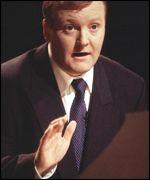
- touches the heart, a gesture of love and being genuine (see Bush picture)
(these gestures are used 25% more when lying, research has shown)

No doubt this data is culturally biased though.

Aside from the above hand gesture clues, you have to pay much closer attention. Liars usually don't give themselves away that easily. Look for changes in breathing, pupil dilation, skin flush, muscle tone changes, even pore size.

Also, look for exaggerated signs of honesty rather than stereotypical signs of lying. It's obvious in a way - liars make sure they avoid any body language that is commonly believed to indicate a liar, and try to imitate the body language of someone telling the truth. Acting - and therefore (indirectly) lying - is something we learn to do since we are very young. We learn to manipulate our body language to make it appropriate to the social situation.

So what about the looking to the right versus looking to the left tactic? (Looking right = invention, accessing part of the brain that constructs information, so would entail lying). Well, apparantly even that is a myth. We construct information even when telling the truth. But this could still be useful if we pay particular attention to what the person is saying - and if it involves constructing information.

So to catch a liar, you have to look closely for fake or exaggerated signs of honesty, listen carefully to see if body language contradicts what they're saying, and of course, ask lots of questions.

Friday, March 10, 2006

Family in Turkey walks on all fours


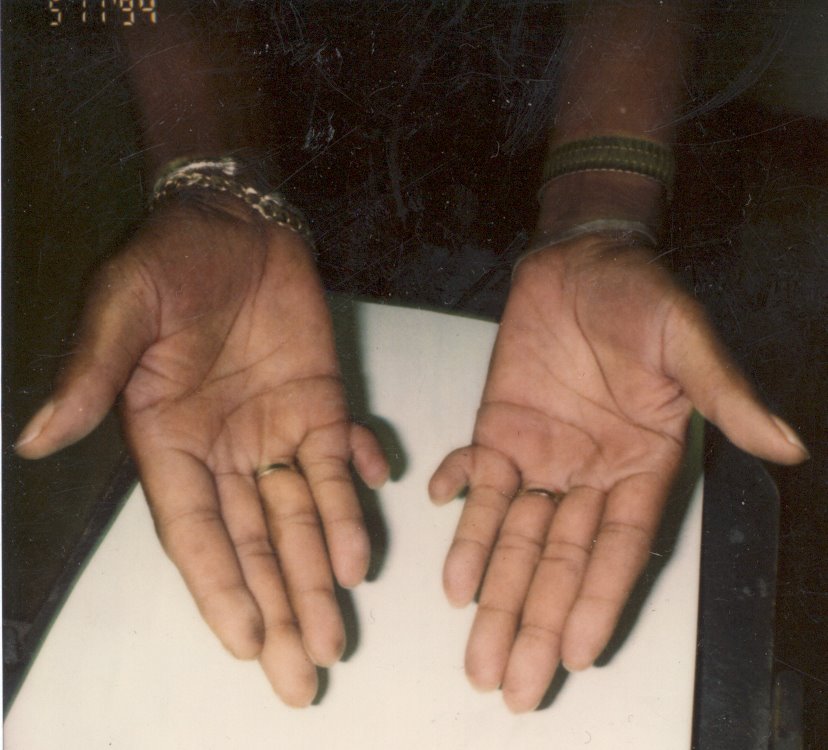
A family of ethnic Kurds has been found in Turkey that are quadrupedal - they walk on hands and feet. Is it a genetic defect? Or is it a missing link to our forebears, who started walking on two feet more than 2 million year ago?

Scientists are still speculating the shift to bipedalism - one theory is that it was merely to be able carry back a larger amount of food - enabling the upright bloke to feed a whole family back home rather than just oneself. Eventually the hands developed further, leading to the multi-functional hands we have today which can bounce basketballs up and down like no Gorilla can. [source: National Geographic]

Wednesday, March 01, 2006

Fun with anagrams

Some celebrity names have really amazing and interesting anagrams. Here's a selection of the best:

Britney Spears: best PR in years
George W Bush: He grew bogus / Bush ego grew / Where bugs go
George Bush: He bugs Gore / O, he buggers / Huger BS ego
President Bush of the USA: A fresh one, but he's stupid
Madonna Louise Ciccone: occasional nude income / one cool dance musician
Justin Timberlake: I'm a jerk, but listen
President Clinton of the USA: he finds interns to copulate
Harry Potter: try hero part
William Shakespeare: I’ll make a wise phrase / I am a weakish speller
Milosevic: Cos I'm evil
Adolf Hitler: Do real filth / Heil, old fart
Osama bin Laden: A bad man (no lies)

Most of these are from: http://www.innocentenglish.com/amazing-anagrams.html
and: http://www.fun-with-words.com/anag_names.html

In the theme of this blog, I tried finding some anagrams of my own:

Palmistry: Simply art
Dermatoglyphics: I'm Godly chapters / I'm God's chapterly

And how do the different palmistry systems fare?

Astrological palmistry: Rolls so pragmatically
Cheiro's palmistry: Is trashy compiler
Chinese palmistry: In mystical sphere / shapelier'n mystic
Chinese taoist chiromancy: Atheistic, concise harmony
Elemental palmistry: Sly, manlier template / Silly, temperamental
European palmistry: A monetary supplier / merry utopian pleas
Indian palmistry: I'm saintly 'n rapid / and mainly spirit
Oriental palmistry: Is really important
Traditional palmistry: Optimally sad irritant
Victorian palmistry: Inapt or rival mystic / Strip, I'm clairvoyant
English Victorian palmistry: Politely striving anarchism

The different palmistry systems were taken mostly from Christopher Jones' History of Handreading

Anagram genius was used to create these anagrams.

Thursday, January 19, 2006

Chess and palmistry

Bobby Fischer, former world chess champion, is one of the greatest chess players of all time. Garry Kasparov wrote that of all world champions of chess, the skill gap between Fischer and his contemporaries was the largest in history. Fischer became the U.S. Champion at the tender age of 14 (the youngest ever, and with 0 losses), and went on to became the world's youngest ever Grandmaster (although this record no longer stands).

Well what does this have to do with palmistry?

Well, Fischer is actually a firm believer in palmistry. A quote from an interview: "Palmistry is a definite science. It's not just a bunch of nonsense like astrology." And about his own palms, he says they "show a flexible mind and a soul that has been callused by the hard knocks of life. Like I'm not as soft or as generous a person as I would be if the world hadn't changed me." [source: chessmaniac.com]

This provided some inspiration to look at the palm as if it were a chessboard, as Fischer might have done. The five different chesspieces (excluding the King) actually make interesting metaphors for the five fingers, similar to the two popular systems of palmistry - astrological palmistry (planet metaphors - jupiter, venus, mars, etc.) and 4 element handreading (air, water, earth, fire). So, without further delay, I hereby introduce: chess palmistry!
(due to the nature of chess it is kind of 'battle' oriented)

Thumb = the Queen. Like the thumb on the hand, the queen is easily the greatest force of power. It is also the most flexible piece, able to move in all directions. It is without doubt the captain of the ship, but still needs to work together with the other pieces in order to unleash its full power.

Index finger = the Bishop. Like the index finger, the bishop is the first to get out into the open and expose itself. For this reason, its usually the first to pose a threat.

Middle finger = the Castle (rook). Like the middle finger, the castle is the stabilizing core - strong and powerful, second only to the queen, but its influence is more often behind the scenes - until the final kill.

Ring finger = the Horse. Like the ring finger, the horse is the most unpredictable, creative, and distinct. While equal in strength to the bishop, it's tactics are more subtle and indirect.

Little finger = the Pawn. Like the little finger, the pawn is subtle and seemingly weak, but its influence should not be understimated. Often, the pawn becomes the most powerful of all, and it is through the hidden strength of the pawn that one tries to outwit the opponent.

Friday, November 18, 2005

Interesting hands

Hand skin's like elephant hide


How big is your hand?


Hello hello hello hello


Which one's the little finger?

Tuesday, November 08, 2005

Orangutan paints in free time


Nonja is an orangutan residing at Schoenbrunn Zoo in Vienna. She treads in the footsteps of chimp Conga, a succesful artist who sold paintings at a London auction for £14,400.

Congo, who was born in 1954, produced some 400 drawings and paintings between the ages of two and four.

The previous post in this blog mentioned that Neanderthals have hands as nimble as humans. Well the picture above shows that orangutans have hands nimble enough to handle a paintbrush! We humans aren't so special after all...(or are you an orangutan reading this?)

See also:

Friday, November 04, 2005

Surprising finger facts

  • Fingers don't have muscles - fingers are actually moved like puppets on a string, the strings being the tendons which are moved by the muscles of the forearm.
  • Most autistic children don't point - so this is used as a diagnostic test for autism. They also tend to have unusually long ring fingers compared to their index fingers.
  • Guys usually have longer ring fingers than index fingers, girls vice versa - caused by differences in hormone levels (oestrogen and testosterone), this ratio has been shown to be very significant. It indicates such things as fertility, musical and sports aptitude, health and disease, and recently it was found that it can even show whether you are more likely to have a scientific or a social science brain.
  • Index finger best one to lose - although it seems you need this finger more than any other, hand surgeons say that this is the best one to lose (if you had a choice given by terrorists, say). Fingers are most useful working together, and in this case the index finger is needed the least.
  • Neanderthals have nimble fingers - contrary to the typical image of Neanderthals as club-wielding, barbaric buffoons, archaeologists have found that they not only had larger brains than us humans, but also that their fingers were just as nimble as ours.
  • Fingernails show your state of health - brittle, pale or bluish fingernails are usually bad signs. The nails can indicate problems such as thyroid, anemia, vitamin or mineral deficiencies and liver trouble. Also check horizontal ridges or small indentations - these are indicators of high stress in your recent past - when exactly can be found roughly by checking where on the nail they are (up to a few months ago when close to the tip).
See also other recent handlines blog entries:
And a BBC radio series that looks at each of the fingers.

Sunday, October 23, 2005

Hand gestures: some tricks from politicians


As much as 80% if communications is in the body language, and hands are one of the most important aspects to consider. Politicians are generally well trained in the art of hand gestures. Robert Phipps, a specialist who advises salespeople and politicians on effective communication, reveals some of their tricks:
  • Show your hands: Never place hands in pockets or behind your back, but always in full view. Otherwise the message is: I cannot be trusted.
  • Nothing crossed: Keep arms and legs uncrossed, possibly even leave your jacket unbuttoned. This means: I am open and honest with you.
  • Keep it low: Don't turn palms too far upwards or raise arms too high. This is a sign of surrender, and weakness. But palms slightly up and outwards is seen as open and friendly.
  • Palms down: The opposite of the above - this comes across as authoritarian and slightly threatening, so should be used with caution.
  • "I am in control gesture": This is done by extending the hands and then turning the palms downwards in a sort of patting motion. It's favoured by politicians, but has to be used with care. Better, according to Mr. Phipps, is first showing the hands are empty, and in a seamless movement cupping them slightly and moving them towards the body.
See also the top ten tips from bodylanguagetraining.com.

Tuesday, October 18, 2005

Indian boy has 25 fingers, toes

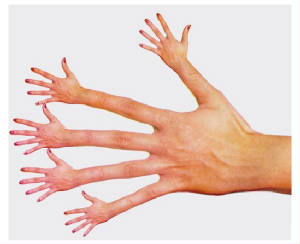
"Devender Harne, 10, was born with 25 fingers and toes -- six fingers on each hand, six toes on one foot and seven on the other." video link.

Devender says his extra fingers and toes are a help rather than a hindrance. "Unlike other instances where the extra physical feature is not fully-grown or is of no use, Devender's toes and fingers are active and normal in size."

The Guinness Book of World Records is investigating whether he has the most usable fingers and toes in the world.

Tuesday, October 11, 2005

Biometrics on the rise


From CNN.com: [oktober 11, '05] "They walk up to an ATM and press their thumbs on the screen. Out spits the cash. - New York? No. Chicago? No. The mountains and jungles of Colombia"

The use of Biometrics (human identification through physical or behavioral characteristics) is on the rise. Yet in some markets, such as the US, progress has been slow: the issue of privacy is one of the main reasons. South America has become a budding market for fingerprint technology, because people are already used to using fingerprints for identification.

Some of the latest technologies are very interesting, for example body odor or brainwave recognition, or analyzing your typing rhythm!

The use of biometrics would have been much more widespread, if it were not for some problems: none of the technologies are completely reliable, they tend to be quite costly, and some are inefficient. There are also many people who feel uneasy with the most commonly used biometrics technologies, such as fingerprint and eye recognition. Sticking your eye in front of your camera, putting your finger or hand on a surface touched by thousands of others, and having personal things about ourselves recorded - not everyone feels comfortable with that. For all these reasons, a lot of different biometrics technologies are still being developed and tried out.

Aside from fingerprint identification, other types of Biometrics are:
  • Facial recognition - based on facial features or pattern of flood vessels underneath the skin.
  • Hand geometry - based on the shape of the hand or the pattern of the veins
  • Eye recognition - based on either iris (which surrounds the pupil) or retina (pattern of blood vessels at the back of the eye).
  • Voice verification
  • Signature recognition
  • Keystroke dynamics - the rhythm with which one types is distinctive!
  • Nail recognition
  • DNA

Biometrics technologies still under development:

  • Mouse dynamics
  • Gait recognition - the way you walk
  • Scent and body odor
  • Automated Dental Identification System
  • Ear lobe measurements
  • Thermal emission
  • Brainwave reading
  • More

The fact that the fingerprint lines or dermatoglyphics can reveal information about ourselves, such as diseases, is dispelled as a myth by biometrics developers and researchers. True, the biometrics technologies probably do not record the relevant information from our hands. However, the idea that these lines reveal information about ourselves is of course not a myth at all: those who say so just have not been keeping up with the latest research. Or they are purposefully ignoring it in order to market their biometrics technologies.

Wednesday, October 05, 2005

Left-handers better at survival


...and he said, "Yes, God did it and he did it left handed."This confused me a bit, so I asked,"What makes you say God did this with his left hand?"

"Well," he said, "we learned at Sunday School last week that Jesus sits on God's right hand"

Fact1: One in every 10 people is left-handed. Males are almost one-and-a-half times more likely to be left-handed than females.

Fact2: Left-handers are more likely to have health problems, and score in more extreme ranges (high/low) in IQ tests compared to right-handers.

Fact 3: Left handers have an advantage in sports. A higher than average number of successful sportspeople are left-handers.

Debated: Some researchers say that left-handers are more likely to be creative.

Latest Fact: [Dec. '04] Researchers in France found that in violent cultures there is a higher incidence of left-handed people. They speculate that left handers are more likely to survive in a fight. Whatever the reason, left handers have shown to be better at survival. Otherwise, considering that they are more likely to have health problems, they would have become extinct. [source: New Scientist]

Some famous left handers: Homer and Bart Simpson, Matt Groening, Beethoven, DaVinci, Henry Ford, Einstein, Newton, Bill Gates, Alexander the Great, Charlie Chaplin, Morgan Freeman, Jay Leno, Oprah Winfrey, Robert Redford and Robert De Niro.

External links

Saturday, October 01, 2005

Human Hands emit Light!

A study by Misuo Hiramatsu at Hamamatsu Photonics in Japan discovered that human hands emit light all the time, in particular the fingernails. Other parts of the body that emit light are the forehead and bottoms of our feet.

"The detector found that fingernails release 60 photons, fingers release 40 and the palms are the dimmest of all, with 20 photons measured."

Fritz-Albert Popp, a leading world expert on biologically related photons, believes that the light pulses out with basic rhythms, but become irregular in unhealthy people. In the future, the light from our hands and rest of our body may be used to diagnose medical problems.

Wednesday, September 28, 2005

Do you have a Passion Line?


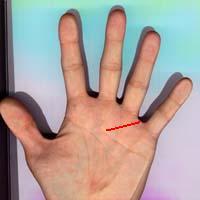
Do you think you are kinky? Have a look and see if you have a passion line on one or both of your hands (see picture left).

This has got to be one of the most interesting lines on the hand. The passion line is a line that goes from between the ring and little finger towards what is known by handreaders as the 'heart line'. The heart line is one of the three strongest lines on the palm. It crosses the palm horizontally, starting from the little finger side and ending somewhere below the middle and index finger (sometimes swooping upwards to the index finger). Palm lines in the area above the heart line, such as the passion line, tend to be found on people who are very sensual and enjoy flights of fantasy.

It is not uncommon to see a semi-circle type of formation, starting between the ring and little finger and ending between the index and middle finger. This is known as the 'girle of venus', and used to be known as the 'sex drugs and rock'n roll' line in traditional palmistry. It is said to be found on thrill seekers.

The passion line is more of a straight, rather than curved, line, plunging directly towards the heartline and sometimes passing through it. Its significance was discovered by Johnny Fincham. Not everyone has this marking, and a clear, deep line, unwavering and unbroken line is quite uncommon. It is said to be a sign of those who are kinky and like to explore their sexuality.

Tuesday, September 20, 2005

Do you have unusual fingerprints?

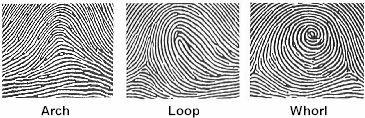
Below are the three basic pattern types. The loop is the most common fingerprint pattern all over the world.

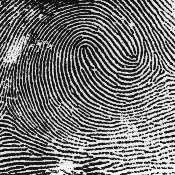
To identify the three patterns, note the 'delta', the point where lines from three directions come together. The whorl has two deltas, the loop has one (see bottom-left), and the arch has no delta at all.

Which fingerprints are most rare?

Below are some pictures of less common fingerprints patterns.
Send me a picture/scan of your palm or fingerprint if you have trouble identifying it (frvc [at] dse [dot] nl).

Double Loop

Peacock's eye
Tented Arch

To see if you have an unusual or rare fingerprint, check which finger it is found on. For example, a radial loop is common on the index finger, but extremely rare on the little finger.

Uncommon fingerprint: less than 1 in 20 people have such a fingerprint.
Rare fingerprint: less than 1 in 100 people have such a fingerprint.
Extremely rare fingerprint: less than 1 in 1000 people have such a fingerprint.

In order from most common to most rare:

  1. Ulnar loop = a loop that comes from the pinky side of the hand
    - So common, it is quite rare NOT to have one!
  2. Whorl = a spiral pattern
    - Very common, especially on the thumb, index and ring fingers
  3. Radial loop = a loop that comes from the thumb side of the hand
    - Commonly found on index finger, uncommon on middle finger, rare on other fingers
    =====================
    UNCOMMON FINGERPRINTS:
    =====================
  4. Arch = most simple fingerprint, no loop patterns
    - Uncommon pattern on: all fingers, rare on little finger
  5. Double loop = two loops going in two directions, but is actually a type of whorl
    - Uncommon pattern on: all fingers except thumb, rare on ring and little fingers
  6. Peacock's eye = a tiny whorl inside a loop
    - Uncommon pattern on: all fingers, most common on ring finger, rare on thumb.
    ===============
    RARE FINGERPRINTS:
    ===============
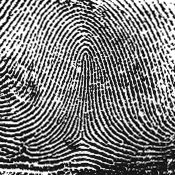
  7. Tented arch = arch pattern but horizontal ridges rising up high in the middle, creating a tent-like pattern. Note: the tented arch is often confused with a loop that looks like a tented arch. Look for any signs of a loop to check if it is a 'real' tented arch.
    - Rare on all fingers, extremely rare on thumb and little finger
  8. Accidental = anything else, such as horizontal rather than vertical loops
    - Rare on index finger, extremely rare on all other fingers

Source used: Fingerprints, palms and soles, Cummins, H., 1943


Character traits

Handreaders have associated fingerprints with certain character traits.
  • Loops*: flexible, adaptable, easy going, highly receptive, impressionable, unfocussed, team players.
  • Arches: down to earth, pragmatic, responsible, reserved, consistent.
  • Tented arches: hyperactive, impulsive, intense, fiery.
  • Whorls*: independent, inflexible, individualistic, highly focussed.
  • Double loop (a.k.a. composite): indecisive, uncertain, diplomatic. Some double loops look more like whorls, others are more clearly two intertwined loops. Depending on which one it is, see also the associated loop or whorl characteristics.
  • Peacock's eye (a.k.a. central pocket loop): perfectionistic, good eye for detail. It is more of a whorl than a loop, so see also whorl characteristics.

*Note that loops and whorls are quite common - so it would take about 4+ whorls to make you a 'whorly' person and 7+ loops to make you a 'loopy' person.

Handreaders also give specific meaning to the fingers. To interpret the meaning, you need to combine all the characteristics, and this takes experience (say, getting people's feedback from reading at least 1000 hands). But it can be fun linking the fingerprints characteristics to the individual fingers:

  • Thumb: Willpower/control
  • Index: Public image, self expression
  • Middle finger: Values, morals
  • Ring finger: Aesthetics, creativity
  • Pinky: Communication

The meaning also depends on the hand you look at - this is if you have different fingerprints on your left hand compared to your right hand:

  • Dominant hand (right if right handed): Public self
  • Passive hand: Private self

Fingerprints on your palm?

Do you have any fingerprints on your palm? Is it a loop inbetween two fingers? No? Congratulations, whatever it is automatically qualitifies as an uncommon palm pattern! One or more loops are usually found on the area of the palm between the fingers. The one between the ring finger and pinky is commonly called the 'humor loop', and between the ring and middle fingers is called the 'loop of seriousness' (draw your own conclusion about this one...but it refers to 'type' of humor rather than humor itself). A loop between the index and middle fingers is quite rare, and is a sign of royal lineage in Indian traditional palmistry. Some people also have loops or arches elsewhere, most commonly in the area around the base of the thumb. It is also quite common to have a loop on the side of the palm opposite the thumb, about halfway up, which is called a memory loop. A whorl print is very rare anywhere on the palm.

Fingerprints around the world

In some human populations whorls are more common, such as among aboriginal Australians, Eskimos and in some parts of Asia. Europeans tend to have more loops. Arches are more common among the Bushmen, Efe pygmies and oddly enough, the Dutch. Nevertheless, the order of commonness: loop -> whorl -> arch, is the same everywhere.

Can fingerprints be forged?

Apparently it is not too difficult to fool a fingerprint security system. Check out this demonstration from MythBusters:

Can fingerprints be forged? - EduTube

Recommended links

Monday, September 19, 2005

Most popular body parts in the English language

This is an excellent word count tool that presents "86,800 most frequently used English words, ranked in order of commonness".

Also interesting is query count, the most common queries in wordcount. The results are not exactly surprising (see below).

Some of the results:
Most talked about
body parts
We are most
curious about:
Body

Head: 222
Hand: 238
Face: 246
Eyes: 291
Hair: 682
Feet: 698

Fingers: 1769
Lips: 2026
Nose: 2335
Ears: 3168
Palm: 5937
Thumb: 6487
Toes: 6895
Fingerprints: 18785
Pinky: 40363

Senses

See: 85
Feel: 329
Hear: 704
Touch: 1539
Taste: 2429
Smell: 2633

Ass: 9
T*ts: 75
Hair: 495
Hand: 545
Finger: 699
Face: 749
Lips: 2543
Thumb: 5024

Friday, September 16, 2005

Football players chop fingers to improve game


First Daniel Chick had a ring finger amputated (see pic) and bone removed in his shoulder for his football career, and now another Australian football player just had his finger amputated. All for the love of the game. Brett Backwell also had his left ring finger removed because of pain and lack of movement from an earlier injury, which affected his ability to handle the ball.
"It's not something that's been done lightly and to chop a finger off, it's a bit drastic. But I love my footy and love playing sport and if that's going to help me to succeed at this level then it's something you've just got to do."

Thursday, September 15, 2005

Hand sculptures and art

For more artworks and full-sized foto's check out Martijn's website.
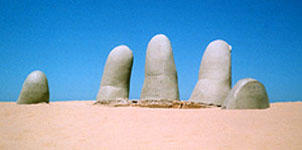
Punta del Este (Uruguay)
Escher: Drawing hands

La Mano del Desierto, Chili
The Thumb, Shanghai

The Thumb, Paris

Saturday, September 10, 2005

Human finger munchers - jailed

A couple is charged for putting a human finger in a Wendy's burger and filing a law-suit against Wendy's. "Ms Ayala's claim is said to have cost the third-largest US burger chain $2.5m (£1.3m) in lost sales." Wendy's offered a $100,000 reward for information on whose that was.

The couple pleaded guilty and the finger owner, a construction worker, has been found. The finger, lost in an industrial accident, was sold for only $100.