| Below are the three basic pattern types. The loop is the most common fingerprint pattern all over the world. | |||
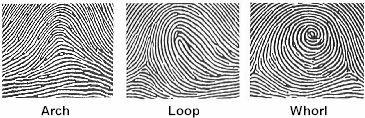 | |||
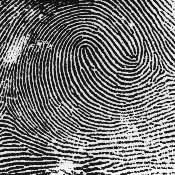
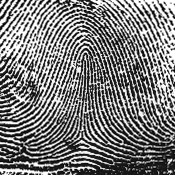
To identify the three patterns, note the 'delta', the point where lines from three directions come together. The whorl has two deltas, the loop has one (see bottom-left), and the arch has no delta at all. Which fingerprints are most rare? Below are some pictures of less common fingerprints patterns.
To see if you have an unusual or rare fingerprint, check which finger it is found on. For example, a radial loop is common on the index finger, but extremely rare on the little finger. Uncommon fingerprint: less than 1 in 20 people have such a fingerprint. In order from most common to most rare:
Source used: Fingerprints, palms and soles, Cummins, H., 1943 | |||
Character traits Handreaders have associated fingerprints with certain character traits.
*Note that loops and whorls are quite common - so it would take about 4+ whorls to make you a 'whorly' person and 7+ loops to make you a 'loopy' person.
The meaning also depends on the hand you look at - this is if you have different fingerprints on your left hand compared to your right hand:
Fingerprints on your palm? Do you have any fingerprints on your palm? Is it a loop inbetween two fingers? No? Congratulations, whatever it is automatically qualitifies as an uncommon palm pattern! One or more loops are usually found on the area of the palm between the fingers. The one between the ring finger and pinky is commonly called the 'humor loop', and between the ring and middle fingers is called the 'loop of seriousness' (draw your own conclusion about this one...but it refers to 'type' of humor rather than humor itself). A loop between the index and middle fingers is quite rare, and is a sign of royal lineage in Indian traditional palmistry. Some people also have loops or arches elsewhere, most commonly in the area around the base of the thumb. It is also quite common to have a loop on the side of the palm opposite the thumb, about halfway up, which is called a memory loop. A whorl print is very rare anywhere on the palm. Fingerprints around the world In some human populations whorls are more common, such as among aboriginal Australians, Eskimos and in some parts of Asia. Europeans tend to have more loops. Arches are more common among the Bushmen, Efe pygmies and oddly enough, the Dutch. Nevertheless, the order of commonness: loop -> whorl -> arch, is the same everywhere. Can fingerprints be forged? Apparently it is not too difficult to fool a fingerprint security system. Check out this demonstration from MythBusters: Can fingerprints be forged? - EduTube Recommended links
|
Showing posts with label exotic. Show all posts
Showing posts with label exotic. Show all posts
Tuesday, September 20, 2005
Do you have unusual fingerprints?



Subscribe to:
Posts (Atom)