Sunday, October 23, 2005

Hand gestures: some tricks from politicians


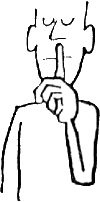
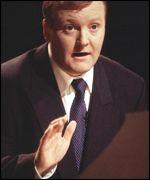
As much as 80% if communications is in the body language, and hands are one of the most important aspects to consider. Politicians are generally well trained in the art of hand gestures. Robert Phipps, a specialist who advises salespeople and politicians on effective communication, reveals some of their tricks:
  • Show your hands: Never place hands in pockets or behind your back, but always in full view. Otherwise the message is: I cannot be trusted.
  • Nothing crossed: Keep arms and legs uncrossed, possibly even leave your jacket unbuttoned. This means: I am open and honest with you.
  • Keep it low: Don't turn palms too far upwards or raise arms too high. This is a sign of surrender, and weakness. But palms slightly up and outwards is seen as open and friendly.
  • Palms down: The opposite of the above - this comes across as authoritarian and slightly threatening, so should be used with caution.
  • "I am in control gesture": This is done by extending the hands and then turning the palms downwards in a sort of patting motion. It's favoured by politicians, but has to be used with care. Better, according to Mr. Phipps, is first showing the hands are empty, and in a seamless movement cupping them slightly and moving them towards the body.
See also the top ten tips from bodylanguagetraining.com.

Tuesday, October 18, 2005

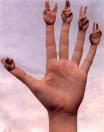
Indian boy has 25 fingers, toes

"Devender Harne, 10, was born with 25 fingers and toes -- six fingers on each hand, six toes on one foot and seven on the other." video link.

Devender says his extra fingers and toes are a help rather than a hindrance. "Unlike other instances where the extra physical feature is not fully-grown or is of no use, Devender's toes and fingers are active and normal in size."

The Guinness Book of World Records is investigating whether he has the most usable fingers and toes in the world.

Tuesday, October 11, 2005

Biometrics on the rise


From CNN.com: [oktober 11, '05] "They walk up to an ATM and press their thumbs on the screen. Out spits the cash. - New York? No. Chicago? No. The mountains and jungles of Colombia"

The use of Biometrics (human identification through physical or behavioral characteristics) is on the rise. Yet in some markets, such as the US, progress has been slow: the issue of privacy is one of the main reasons. South America has become a budding market for fingerprint technology, because people are already used to using fingerprints for identification.

Some of the latest technologies are very interesting, for example body odor or brainwave recognition, or analyzing your typing rhythm!

The use of biometrics would have been much more widespread, if it were not for some problems: none of the technologies are completely reliable, they tend to be quite costly, and some are inefficient. There are also many people who feel uneasy with the most commonly used biometrics technologies, such as fingerprint and eye recognition. Sticking your eye in front of your camera, putting your finger or hand on a surface touched by thousands of others, and having personal things about ourselves recorded - not everyone feels comfortable with that. For all these reasons, a lot of different biometrics technologies are still being developed and tried out.

Aside from fingerprint identification, other types of Biometrics are:
  • Facial recognition - based on facial features or pattern of flood vessels underneath the skin.
  • Hand geometry - based on the shape of the hand or the pattern of the veins
  • Eye recognition - based on either iris (which surrounds the pupil) or retina (pattern of blood vessels at the back of the eye).
  • Voice verification
  • Signature recognition
  • Keystroke dynamics - the rhythm with which one types is distinctive!
  • Nail recognition
  • DNA

Biometrics technologies still under development:

  • Mouse dynamics
  • Gait recognition - the way you walk
  • Scent and body odor
  • Automated Dental Identification System
  • Ear lobe measurements
  • Thermal emission
  • Brainwave reading
  • More

The fact that the fingerprint lines or dermatoglyphics can reveal information about ourselves, such as diseases, is dispelled as a myth by biometrics developers and researchers. True, the biometrics technologies probably do not record the relevant information from our hands. However, the idea that these lines reveal information about ourselves is of course not a myth at all: those who say so just have not been keeping up with the latest research. Or they are purposefully ignoring it in order to market their biometrics technologies.
Wednesday, October 05, 2005

Left-handers better at survival


...and he said, "Yes, God did it and he did it left handed."This confused me a bit, so I asked,"What makes you say God did this with his left hand?"

"Well," he said, "we learned at Sunday School last week that Jesus sits on God's right hand"

Fact1: One in every 10 people is left-handed. Males are almost one-and-a-half times more likely to be left-handed than females.

Fact2: Left-handers are more likely to have health problems, and score in more extreme ranges (high/low) in IQ tests compared to right-handers.

Fact 3: Left handers have an advantage in sports. A higher than average number of successful sportspeople are left-handers.

Debated: Some researchers say that left-handers are more likely to be creative.

Latest Fact: [Dec. '04] Researchers in France found that in violent cultures there is a higher incidence of left-handed people. They speculate that left handers are more likely to survive in a fight. Whatever the reason, left handers have shown to be better at survival. Otherwise, considering that they are more likely to have health problems, they would have become extinct. [source: New Scientist]

Some famous left handers: Homer and Bart Simpson, Matt Groening, Beethoven, DaVinci, Henry Ford, Einstein, Newton, Bill Gates, Alexander the Great, Charlie Chaplin, Morgan Freeman, Jay Leno, Oprah Winfrey, Robert Redford and Robert De Niro.

External links

Saturday, October 01, 2005

Human Hands emit Light!

A study by Misuo Hiramatsu at Hamamatsu Photonics in Japan discovered that human hands emit light all the time, in particular the fingernails. Other parts of the body that emit light are the forehead and bottoms of our feet.

"The detector found that fingernails release 60 photons, fingers release 40 and the palms are the dimmest of all, with 20 photons measured."

Fritz-Albert Popp, a leading world expert on biologically related photons, believes that the light pulses out with basic rhythms, but become irregular in unhealthy people. In the future, the light from our hands and rest of our body may be used to diagnose medical problems.

Wednesday, September 28, 2005

Do you have a Passion Line?


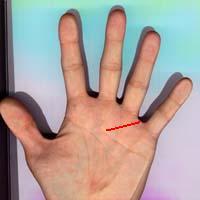
Do you think you are kinky? Have a look and see if you have a passion line on one or both of your hands (see picture left).

This has got to be one of the most interesting lines on the hand. The passion line is a line that goes from between the ring and little finger towards what is known by handreaders as the 'heart line'. The heart line is one of the three strongest lines on the palm. It crosses the palm horizontally, starting from the little finger side and ending somewhere below the middle and index finger (sometimes swooping upwards to the index finger). Palm lines in the area above the heart line, such as the passion line, tend to be found on people who are very sensual and enjoy flights of fantasy.

It is not uncommon to see a semi-circle type of formation, starting between the ring and little finger and ending between the index and middle finger. This is known as the 'girle of venus', and used to be known as the 'sex drugs and rock'n roll' line in traditional palmistry. It is said to be found on thrill seekers.

The passion line is more of a straight, rather than curved, line, plunging directly towards the heartline and sometimes passing through it. Its significance was discovered by Johnny Fincham. Not everyone has this marking, and a clear, deep line, unwavering and unbroken line is quite uncommon. It is said to be a sign of those who are kinky and like to explore their sexuality.

Tuesday, September 20, 2005

Do you have unusual fingerprints?

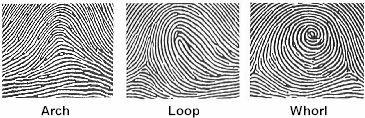
Below are the three basic pattern types. The loop is the most common fingerprint pattern all over the world.

To identify the three patterns, note the 'delta', the point where lines from three directions come together. The whorl has two deltas, the loop has one (see bottom-left), and the arch has no delta at all.

Which fingerprints are most rare?

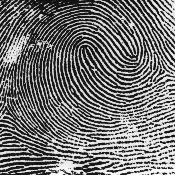
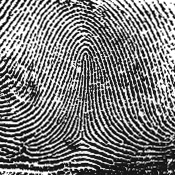
Below are some pictures of less common fingerprints patterns.
Send me a picture/scan of your palm or fingerprint if you have trouble identifying it (frvc [at] dse [dot] nl).

Double Loop

Peacock's eye
Tented Arch

To see if you have an unusual or rare fingerprint, check which finger it is found on. For example, a radial loop is common on the index finger, but extremely rare on the little finger.

Uncommon fingerprint: less than 1 in 20 people have such a fingerprint.
Rare fingerprint: less than 1 in 100 people have such a fingerprint.
Extremely rare fingerprint: less than 1 in 1000 people have such a fingerprint.

In order from most common to most rare:

  1. Ulnar loop = a loop that comes from the pinky side of the hand
    - So common, it is quite rare NOT to have one!
  2. Whorl = a spiral pattern
    - Very common, especially on the thumb, index and ring fingers
  3. Radial loop = a loop that comes from the thumb side of the hand
    - Commonly found on index finger, uncommon on middle finger, rare on other fingers
    =====================
    UNCOMMON FINGERPRINTS:
    =====================
  4. Arch = most simple fingerprint, no loop patterns
    - Uncommon pattern on: all fingers, rare on little finger
  5. Double loop = two loops going in two directions, but is actually a type of whorl
    - Uncommon pattern on: all fingers except thumb, rare on ring and little fingers
  6. Peacock's eye = a tiny whorl inside a loop
    - Uncommon pattern on: all fingers, most common on ring finger, rare on thumb.
    ===============
    RARE FINGERPRINTS:
    ===============
  7. Tented arch = arch pattern but horizontal ridges rising up high in the middle, creating a tent-like pattern. Note: the tented arch is often confused with a loop that looks like a tented arch. Look for any signs of a loop to check if it is a 'real' tented arch.
    - Rare on all fingers, extremely rare on thumb and little finger
  8. Accidental = anything else, such as horizontal rather than vertical loops
    - Rare on index finger, extremely rare on all other fingers

Source used: Fingerprints, palms and soles, Cummins, H., 1943


Character traits

Handreaders have associated fingerprints with certain character traits.
  • Loops*: flexible, adaptable, easy going, highly receptive, impressionable, unfocussed, team players.
  • Arches: down to earth, pragmatic, responsible, reserved, consistent.
  • Tented arches: hyperactive, impulsive, intense, fiery.
  • Whorls*: independent, inflexible, individualistic, highly focussed.
  • Double loop (a.k.a. composite): indecisive, uncertain, diplomatic. Some double loops look more like whorls, others are more clearly two intertwined loops. Depending on which one it is, see also the associated loop or whorl characteristics.
  • Peacock's eye (a.k.a. central pocket loop): perfectionistic, good eye for detail. It is more of a whorl than a loop, so see also whorl characteristics.

*Note that loops and whorls are quite common - so it would take about 4+ whorls to make you a 'whorly' person and 7+ loops to make you a 'loopy' person.

Handreaders also give specific meaning to the fingers. To interpret the meaning, you need to combine all the characteristics, and this takes experience (say, getting people's feedback from reading at least 1000 hands). But it can be fun linking the fingerprints characteristics to the individual fingers:

  • Thumb: Willpower/control
  • Index: Public image, self expression
  • Middle finger: Values, morals
  • Ring finger: Aesthetics, creativity
  • Pinky: Communication

The meaning also depends on the hand you look at - this is if you have different fingerprints on your left hand compared to your right hand:

  • Dominant hand (right if right handed): Public self
  • Passive hand: Private self

Fingerprints on your palm?

Do you have any fingerprints on your palm? Is it a loop inbetween two fingers? No? Congratulations, whatever it is automatically qualitifies as an uncommon palm pattern! One or more loops are usually found on the area of the palm between the fingers. The one between the ring finger and pinky is commonly called the 'humor loop', and between the ring and middle fingers is called the 'loop of seriousness' (draw your own conclusion about this one...but it refers to 'type' of humor rather than humor itself). A loop between the index and middle fingers is quite rare, and is a sign of royal lineage in Indian traditional palmistry. Some people also have loops or arches elsewhere, most commonly in the area around the base of the thumb. It is also quite common to have a loop on the side of the palm opposite the thumb, about halfway up, which is called a memory loop. A whorl print is very rare anywhere on the palm.

Fingerprints around the world

In some human populations whorls are more common, such as among aboriginal Australians, Eskimos and in some parts of Asia. Europeans tend to have more loops. Arches are more common among the Bushmen, Efe pygmies and oddly enough, the Dutch. Nevertheless, the order of commonness: loop -> whorl -> arch, is the same everywhere.

Can fingerprints be forged?

Apparently it is not too difficult to fool a fingerprint security system. Check out this demonstration from MythBusters:

Can fingerprints be forged? - EduTube

Recommended links

Monday, September 19, 2005

Most popular body parts in the English language

This is an excellent word count tool that presents "86,800 most frequently used English words, ranked in order of commonness".

Also interesting is query count, the most common queries in wordcount. The results are not exactly surprising (see below).

Some of the results:
Most talked about
body parts
We are most
curious about:
Body

Head: 222
Hand: 238
Face: 246
Eyes: 291
Hair: 682
Feet: 698

Fingers: 1769
Lips: 2026
Nose: 2335
Ears: 3168
Palm: 5937
Thumb: 6487
Toes: 6895
Fingerprints: 18785
Pinky: 40363

Senses

See: 85
Feel: 329
Hear: 704
Touch: 1539
Taste: 2429
Smell: 2633

Ass: 9
T*ts: 75
Hair: 495
Hand: 545
Finger: 699
Face: 749
Lips: 2543
Thumb: 5024

Friday, September 16, 2005

Football players chop fingers to improve game


First Daniel Chick had a ring finger amputated (see pic) and bone removed in his shoulder for his football career, and now another Australian football player just had his finger amputated. All for the love of the game. Brett Backwell also had his left ring finger removed because of pain and lack of movement from an earlier injury, which affected his ability to handle the ball.
"It's not something that's been done lightly and to chop a finger off, it's a bit drastic. But I love my footy and love playing sport and if that's going to help me to succeed at this level then it's something you've just got to do."

Thursday, September 15, 2005

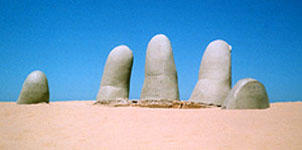
Hand sculptures and art

For more artworks and full-sized foto's check out Martijn's website.
Punta del Este (Uruguay)
Escher: Drawing hands

La Mano del Desierto, Chili
The Thumb, Shanghai

The Thumb, Paris

Saturday, September 10, 2005

Human finger munchers - jailed

A couple is charged for putting a human finger in a Wendy's burger and filing a law-suit against Wendy's. "Ms Ayala's claim is said to have cost the third-largest US burger chain $2.5m (£1.3m) in lost sales." Wendy's offered a $100,000 reward for information on whose that was.

The couple pleaded guilty and the finger owner, a construction worker, has been found. The finger, lost in an industrial accident, was sold for only $100.

Thursday, September 08, 2005

First ever artificial opposable thumb

Those non-moving or single-motor grip prosthetic hands should soon be replaced by a an advanced robot hand.

Lots of people lose their hand every year, such as through motorbike or industrial accidents.

A team at the University of Southampton designed a hand with seperate motors for each finger, and it can be connected to muscles in the arm. The thumb can move in a special way and is flexible and opposable like a human thumb.

The next step is to replicate the human sense of touch.

Wednesday, September 07, 2005

No hands? No problem

Watch this amazing mom with no arms do everything with her feet - taking care of her baby, going to the movies, driving a car and even typing on a keyboard.

Tuesday, September 06, 2005

Forget palmistry, read breasts

After palmistry, phrenology (reading bumps on the head), iridology (iris reading), feet and toe reading, an Italian researcher has now invented the fascinating art of:

BREAST READING

Girls may have experienced this before: a guy coming up to them in a bar, grabbing their hands, and after a quick examination with a caressing finger, get flirtuous remarks thrown at them with here and there references to 'heart line' and 'life line' and so on.

Now imagine an Italian guy coming up to you, examining your breasts, and remarking how they resemble a certain fruit. According to the sexologist, women with lemon breasts are lively and can laugh at themselves. Grapefruit breasts are not a good sign for sex - women with these prefer tenderness. Large and well-rounded breasts are attached to women who like eating and want to be spoiled and admired.

Well, whatever works for you...

Thursday, August 25, 2005

Sign language: look who's talking

Have you ever listened to a baby trying to make conversation with you? The baby is making a genuine attempt, but just isn't able to speak yet.

Sign language solves that problem. Babies as young as 6 months old can communicate with their hands. The average age when babies start saying meaningful words is around 1 year old. With hand signs they can begin communicating a few months earlier.

Teaching babies to sign can improve their language, vocabulary and reading skills. In addition, eight year olds who had learned sign language as babies scored higher on IQ tests. It can also save a lot of frustrations if babies can sign what they want.

Baby signing is becoming more and more popular, with signing classes for parents and babies popping up everywhere. A signing baby doesn't raise as many eyebrows as it did a few years ago. The movie Meet the Fockers, in which the baby signs with Robert de Niro, helped popularize the phenomenon.

Koko signing "koko"
Maybe signing babies is not such a big surprise if you know of Koko, a gorilla who uses over a thousands words of ASL (American Sign Language). With us humans evolving from apes, some scientists believe that we first communicated through sign and developed speech later. What all this definitely shows is the strong brain-hand connection. It's almost as if we have brains inside our hands.

Even if you never learned sign language, you probably still use hand gestures all the time. There's even a guide to Italian hand gestures (handy for those having trouble pronouncing the words). Vivid gestures help get the message across. But did you know that gestures also help us speak? If you're attempting to speak a foreign language, use your hands more. Your hands might be better at foreign languages than you'd think.


Further reading:

Article on baby signs fom Psychology Today

Research on baby signing

koko.org

Wednesday, August 24, 2005

Are you masculine or feminine?

Besides genitalia, relative finger length is the only physical trait at birth that's different in males and females. While still in the womb, the growth of our finger digits is affected by the sex hormones testosterone and estrogen. These hormones also have an effect on our brains.

So how to check? Males tend to have a ring finger that is longer than their index finger (average: 1 to 0.96 ratio), while females typically have index and ring fingers of the same length.

John Manning, a biologist who first identified the significance of 'finger digit ratios', says that "females with masculine digit ratios have more masculine behaviors...males with a typically female ratio exhibit more typically feminine behaviors." Boys with female-type finger lengths tend to be more emotional and sensitive. Girls with the male-type finger lengths tend to be more hyperactive and more predisposed to autism. Lesbians are also more likely to have this finger ratio. Some other characteristics possibly associated with these ratios are musical and sports aptitude; on the negative side, risk of early heart disease and breast cancer.

Read the Psychology Today article

A glimpse of Manning's book