To celebrate |
To push |
To swing |
To throw |
To encourage |
To connect |
To show the way |
To honor |
To greet |
To communicate |
To sense |
To hold on |
To discover |
To point out |
To complain |
To play |
To protect ourselves |
To make ourselves comfortable |
To comfort others |
Sunday, February 11, 2007
Statues show why we need hands


Thursday, January 25, 2007






Thursday, October 26, 2006
What could it BEE ?
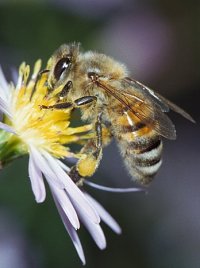 The BEE genome has just been unravelled, and it is hoped to unravel important questions about the intelligent behavior of bees. Bees have brains about 20,000 times less massive than the human brain, yet they are able to recognize faces from black-and-white pictures and even remember them days after training. In contrast, powerful computers still have great difficulty doing that.
So what could it BEE that makes them so good at the task? The clue must lie in the fact that faces, like hands, consist of certain unique patterns. Somehow, bees are able to identify these different patterns, and apparantly, it doesn't take many brain cells to do so.
Monday, August 28, 2006
Hand to replace mouse and keyboard
 A fingertip device that recognises hand gestures and senses texture is being developed in the US.
The digitiser could one day input information without a keyboard; come in handy for gaming, where it could imitate squeezing a trigger; and be worn to paint on a screen by moving a finger through the air.
The 'Fingertip Digitizer', was developed by mechanical engineer Youngseok Kim and Associate Professor Thenkurussi Kesavadas, director of the University at Buffalo's Virtual Reality Laboratory.
They say it could be used for everything from inputting information into a computer or PDA to transferring the physical characteristics of an object to a computer for design purposes.
"With this device a computer, cell phone or computer game could read human intention more naturally," says Kesavadas.
"Eventually the Fingertip Digitizer may be used as a high-end substitute for a mouse, a keyboard or a joystick."
According to Kim and Kesavadas, other gesture-recognition devices available on the market can sense movement but not force.
And although there are several force-feedback, or haptic devices, none can measure details of dynamic fingertip activities, including acceleration and inertia.
"Our digitiser bridges the contact and non-contact input strategy," says Kim. "We keep track of everything happening on your fingertip."
After all, says Kesavadas, the fingertip is the most intuitive interface humans already posses. We use it to point, push buttons, touch objects and sense textures.
If the wearer touches or traces around an object, the motion data is combined with the force-feedback information to determine the object's shape. It will also know if the person is tapping on a table, scratching or snapping fingers, for example.
Read more on News in Science
Saturday, June 03, 2006
Three armed baby born

A baby was born in China with an unusually well-developed third arm. In fact, doctors have difficulty deciding which of the two left arms is the best-developed. Incidentally, the baby was born on the 1st of April, but this is no joke.
"His Shanghai surgeons now must decide which arm to remove, and at this point, they aren't sure which arm will be the one to go."
"Neither of the boy's two left arms is fully functional and tests have so far been unable to determine which was more developed, said Dr. Chen Bochang, head of the orthopedics department at Shanghai Children's Medical Center.
UPDATE: The arm closest to the chest was found to be less developed and has successfully been removed.
"His case is quite peculiar. We have no record of any child with such a complete third arm," Chen said in a telephone interview.
The boy, identified only as "Jie-jie," also was born with just one kidney and may have problems that could lead to curvature of the spine, local media reports said. Jie-jie cried when either of his left arms was touched, but smiled and responded normally to other stimuli, the reports said.
Chen said doctors hoped to work out a plan for surgery, but the boy's small size made it impossible to perform certain tests that would help them prepare.
Media reports said other children have been reported born with additional arms and legs, but in those cases it was clear what limb was more developed. Chen's hospital is one of China's most experienced in dealing with unusual birth defects, including separating conjoined twins."
"While an extra limb is rare, children with multiple digits and even hands are more common, said Dr. Ann Van Heest, an upper extremity surgeon at Gillete Childrens Speciality Healthcare in Minnessota. She has never seen a case like the baby in China. Van Heest estimated that one out of 200,000 babies are born with two thumbs on one hand and one out of 2 million have doubling at the wrist, resulting in two hands."
From: usatoday.com , abcnews.go.comWednesday, May 17, 2006
Early humans had sex with chimps
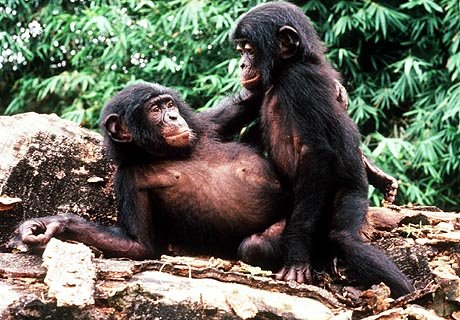 "Our early ancestors interbred with chimpanzees after the two species drew apart millions of years ago, a new paper suggests.
The provocative idea is sketched by US genome experts, who have discovered that hominids and chimps diverged far more recently, and over a much longer timescale, than anyone had thought.
During this time, the authors theorise, the two primates were rather more than kissing cousins: they had sex, swapping genes before making a final separation."
"The ... analysis revealed big surprises, with major implications for human evolution," says Professor Eric Lander, director of the Broad Institute of Harvard University and the Massachusetts Institute of Technology, and co-author of the paper in today's issue of the journal Nature.
Until now, the belief was that humans and chimpanzees shared a common ancestor but went their separate ways around 6.5-7.4 million years ago. "
Genetically, chimpanzees are 98.5% identical to humans.
Looking at DNA
"Exploiting the mountain of data that has come from the human and chimpanzee genome projects, the researchers compared the genetic codes of the two species as they are today.
They believe that the two species made their split no later than 6.3 million years ago and probably less than 5.4 million years ago. In other words, around 1 to 2 million years earlier than the Toumai estimate.
Moreover, speciation of chimp and hominid, the process by which they emerged as separate species, took an extraordinary long time: around four million years in all."
Sex chromososmes
"Previous studies suggest that sex chromosomes are among the most vulnerable of chromosomes when it comes to interbreeding. This is because co-mingling places its genes under swift selective pressure.
Thus something unusual must have happened on the way to speciation: an initial split between human and chimp, followed by interbreeding, whose results show up in progressive younger genes, and then a final separation."
From: News in Science
Wednesday, May 10, 2006
Men's fingers and faces reveal masculinity and attractiveness to women
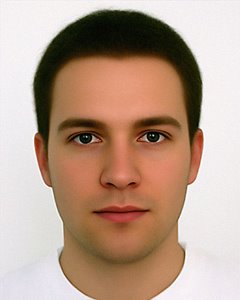
Both our faces and our fingers have a lot to reveal about ourselves.
New research suggests that women can spot subtle signs of interest in children in a man's face, and accurately assess his level of the sex hormone testosterone.
"Women are fine tuned subconsciously to detect the qualities they are looking for in a man - just by looking at his face."
The study was carried out by researchers at the University of Chicago and the University of California, Santa Barbara
Researcher Dr Dario Maestripieri said:
"Our results also show that women value masculinity as a desirable trait for short-term relationships and interest in infants as a desirable trait for more stable long-term relationships."
Pictures of the volunteers were shown to 29 female undergraduates, who were asked to rate the men according to whether they thought they liked children, appeared masculine, physically attractive, or kind. The women were then asked to determine men's attractiveness as short-term romantic partners or as long-term partners for relationships such as marriage.
The men women chose as being most interested in children were the same men who had expressed the most interest in children in the photo test. The women also accurately rated the men with the highest testosterone levels as being the most masculine.
Dr James Roney, who also worked on the study, said: "The research suggests that men's interest in children may be a relatively underappreciated influence on men's long-term mate attractiveness."
Other research, by Dr. Roney and Dr. Maestripieri, suggests that the ratio of the lengths of the second and fourth fingers (2D:4D ratio) is also associated with men's attractiveness as well as with levels of behavioral displays during social interactions with potential mates.
"Our results confirm that male 2D:4D was significantly negatively correlated with women’s ratings of men’s physical attractiveness and levels of courtship-like behavior during a brief conversation. These findings provide novel evidence for the organizational effects of hormones on human male attractiveness and social behavior."
Link to full article.
Another news article on finding mr. Right
A study on the attractiveness of the average face
Monday, March 20, 2006
How to catch a liar? Bodylanguage myths exposed

We all think we know the signs of a liar - twitchy, nervous, blinking, doesn't want to look you straight in the eyes, strokes hair, touches nose.
Well, you're wrong, research shows. It's exactly the opposite. In a study of 130 volunteers, liars touched their noses and stroked their hair 15-20% less than truth tellers. Liars tend to be more still, with fewer movements.
So how do you catch a liar?
Well, look for signs that someone is suddenly more self conscious, more restrained, more concentrated. When the person does make hand gestures, it is to try to come across as honest. Look especially for the following signs:
- holding hands apart to indicate size
- touches the heart, a gesture of love and being genuine (see Bush picture)
(these gestures are used 25% more when lying, research has shown)
No doubt this data is culturally biased though.
 Aside from the above hand gesture clues, you have to pay much closer attention. Liars usually don't give themselves away that easily. Look for changes in breathing, pupil dilation, skin flush, muscle tone changes, even pore size.
Also, look for exaggerated signs of honesty rather than stereotypical signs of lying. It's obvious in a way - liars make sure they avoid any body language that is commonly believed to indicate a liar, and try to imitate the body language of someone telling the truth. Acting - and therefore (indirectly) lying - is something we learn to do since we are very young. We learn to manipulate our body language to make it appropriate to the social situation.
So what about the looking to the right versus looking to the left tactic? (Looking right = invention, accessing part of the brain that constructs information, so would entail lying). Well, apparantly even that is a myth. We construct information even when telling the truth. But this could still be useful if we pay particular attention to what the person is saying - and if it involves constructing information.
So to catch a liar, you have to look closely for fake or exaggerated signs of honesty, listen carefully to see if body language contradicts what they're saying, and of course, ask lots of questions.
Friday, March 10, 2006
Family in Turkey walks on all fours

A family of ethnic Kurds has been found in Turkey that are quadrupedal - they walk on hands and feet. Is it a genetic defect? Or is it a missing link to our forebears, who started walking on two feet more than 2 million year ago?
Scientists are still speculating the shift to bipedalism - one theory is that it was merely to be able carry back a larger amount of food - enabling the upright bloke to feed a whole family back home rather than just oneself. Eventually the hands developed further, leading to the multi-functional hands we have today which can bounce basketballs up and down like no Gorilla can. [source: National Geographic]
Wednesday, March 01, 2006
Fun with anagrams
Some celebrity names have really amazing and interesting anagrams. Here's a selection of the best:
Britney Spears: best PR in years
George W Bush: He grew bogus / Bush ego grew / Where bugs go
George Bush: He bugs Gore / O, he buggers / Huger BS ego
President Bush of the USA: A fresh one, but he's stupid
Madonna Louise Ciccone: occasional nude income / one cool dance musician
Justin Timberlake: I'm a jerk, but listen
President Clinton of the USA: he finds interns to copulate
Harry Potter: try hero part
William Shakespeare: I’ll make a wise phrase / I am a weakish speller
Milosevic: Cos I'm evil
Adolf Hitler: Do real filth / Heil, old fart
Osama bin Laden: A bad man (no lies)
Most of these are from: http://www.innocentenglish.com/amazing-anagrams.html
and: http://www.fun-with-words.com/anag_names.html
In the theme of this blog, I tried finding some anagrams of my own:
Palmistry: Simply art
Dermatoglyphics: I'm Godly chapters / I'm God's chapterly
And how do the different palmistry systems fare?
Astrological palmistry: Rolls so pragmatically
Cheiro's palmistry: Is trashy compiler
Chinese palmistry: In mystical sphere / shapelier'n mystic
Chinese taoist chiromancy: Atheistic, concise harmony
Elemental palmistry: Sly, manlier template / Silly, temperamental
European palmistry: A monetary supplier / merry utopian pleas
Indian palmistry: I'm saintly 'n rapid / and mainly spirit
Oriental palmistry: Is really important
Traditional palmistry: Optimally sad irritant
Victorian palmistry: Inapt or rival mystic / Strip, I'm clairvoyant
English Victorian palmistry: Politely striving anarchism
The different palmistry systems were taken mostly from Christopher Jones' History of Handreading
Anagram genius was used to create these anagrams.
Britney Spears: best PR in years
George W Bush: He grew bogus / Bush ego grew / Where bugs go
George Bush: He bugs Gore / O, he buggers / Huger BS ego
President Bush of the USA: A fresh one, but he's stupid
Madonna Louise Ciccone: occasional nude income / one cool dance musician
Justin Timberlake: I'm a jerk, but listen
President Clinton of the USA: he finds interns to copulate
Harry Potter: try hero part
William Shakespeare: I’ll make a wise phrase / I am a weakish speller
Milosevic: Cos I'm evil
Adolf Hitler: Do real filth / Heil, old fart
Osama bin Laden: A bad man (no lies)
Most of these are from: http://www.innocentenglish.com/amazing-anagrams.html
and: http://www.fun-with-words.com/anag_names.html
In the theme of this blog, I tried finding some anagrams of my own:
Palmistry: Simply art
Dermatoglyphics: I'm Godly chapters / I'm God's chapterly
And how do the different palmistry systems fare?
Astrological palmistry: Rolls so pragmatically
Cheiro's palmistry: Is trashy compiler
Chinese palmistry: In mystical sphere / shapelier'n mystic
Chinese taoist chiromancy: Atheistic, concise harmony
Elemental palmistry: Sly, manlier template / Silly, temperamental
European palmistry: A monetary supplier / merry utopian pleas
Indian palmistry: I'm saintly 'n rapid / and mainly spirit
Oriental palmistry: Is really important
Traditional palmistry: Optimally sad irritant
Victorian palmistry: Inapt or rival mystic / Strip, I'm clairvoyant
English Victorian palmistry: Politely striving anarchism
The different palmistry systems were taken mostly from Christopher Jones' History of Handreading
Anagram genius was used to create these anagrams.
Thursday, January 19, 2006
Chess and palmistry
Bobby Fischer, former world chess champion, is one of the greatest chess players of all time. Garry Kasparov wrote that of all world champions of chess, the skill gap between Fischer and his contemporaries was the largest in history. Fischer became the U.S. Champion at the tender age of 14 (the youngest ever, and with 0 losses), and went on to became the world's youngest ever Grandmaster (although this record no longer stands).
Well what does this have to do with palmistry?
Well, Fischer is actually a firm believer in palmistry. A quote from an interview: "Palmistry is a definite science. It's not just a bunch of nonsense like astrology." And about his own palms, he says they "show a flexible mind and a soul that has been callused by the hard knocks of life. Like I'm not as soft or as generous a person as I would be if the world hadn't changed me." [source: chessmaniac.com]
This provided some inspiration to look at the palm as if it were a chessboard, as Fischer might have done. The five different chesspieces (excluding the King) actually make interesting metaphors for the five fingers, similar to the two popular systems of palmistry - astrological palmistry (planet metaphors - jupiter, venus, mars, etc.) and 4 element handreading (air, water, earth, fire). So, without further delay, I hereby introduce: chess palmistry!
(due to the nature of chess it is kind of 'battle' oriented)
Thumb = the Queen. Like the thumb on the hand, the queen is easily the greatest force of power. It is also the most flexible piece, able to move in all directions. It is without doubt the captain of the ship, but still needs to work together with the other pieces in order to unleash its full power.
Index finger = the Bishop. Like the index finger, the bishop is the first to get out into the open and expose itself. For this reason, its usually the first to pose a threat.
Middle finger = the Castle (rook). Like the middle finger, the castle is the stabilizing core - strong and powerful, second only to the queen, but its influence is more often behind the scenes - until the final kill.
Ring finger = the Horse. Like the ring finger, the horse is the most unpredictable, creative, and distinct. While equal in strength to the bishop, it's tactics are more subtle and indirect.
Little finger = the Pawn. Like the little finger, the pawn is subtle and seemingly weak, but its influence should not be understimated. Often, the pawn becomes the most powerful of all, and it is through the hidden strength of the pawn that one tries to outwit the opponent.
Well what does this have to do with palmistry?
Well, Fischer is actually a firm believer in palmistry. A quote from an interview: "Palmistry is a definite science. It's not just a bunch of nonsense like astrology." And about his own palms, he says they "show a flexible mind and a soul that has been callused by the hard knocks of life. Like I'm not as soft or as generous a person as I would be if the world hadn't changed me." [source: chessmaniac.com]
This provided some inspiration to look at the palm as if it were a chessboard, as Fischer might have done. The five different chesspieces (excluding the King) actually make interesting metaphors for the five fingers, similar to the two popular systems of palmistry - astrological palmistry (planet metaphors - jupiter, venus, mars, etc.) and 4 element handreading (air, water, earth, fire). So, without further delay, I hereby introduce: chess palmistry!
(due to the nature of chess it is kind of 'battle' oriented)
Thumb = the Queen. Like the thumb on the hand, the queen is easily the greatest force of power. It is also the most flexible piece, able to move in all directions. It is without doubt the captain of the ship, but still needs to work together with the other pieces in order to unleash its full power.
Index finger = the Bishop. Like the index finger, the bishop is the first to get out into the open and expose itself. For this reason, its usually the first to pose a threat.
Middle finger = the Castle (rook). Like the middle finger, the castle is the stabilizing core - strong and powerful, second only to the queen, but its influence is more often behind the scenes - until the final kill.
Ring finger = the Horse. Like the ring finger, the horse is the most unpredictable, creative, and distinct. While equal in strength to the bishop, it's tactics are more subtle and indirect.
Little finger = the Pawn. Like the little finger, the pawn is subtle and seemingly weak, but its influence should not be understimated. Often, the pawn becomes the most powerful of all, and it is through the hidden strength of the pawn that one tries to outwit the opponent.
Friday, November 18, 2005
Interesting hands
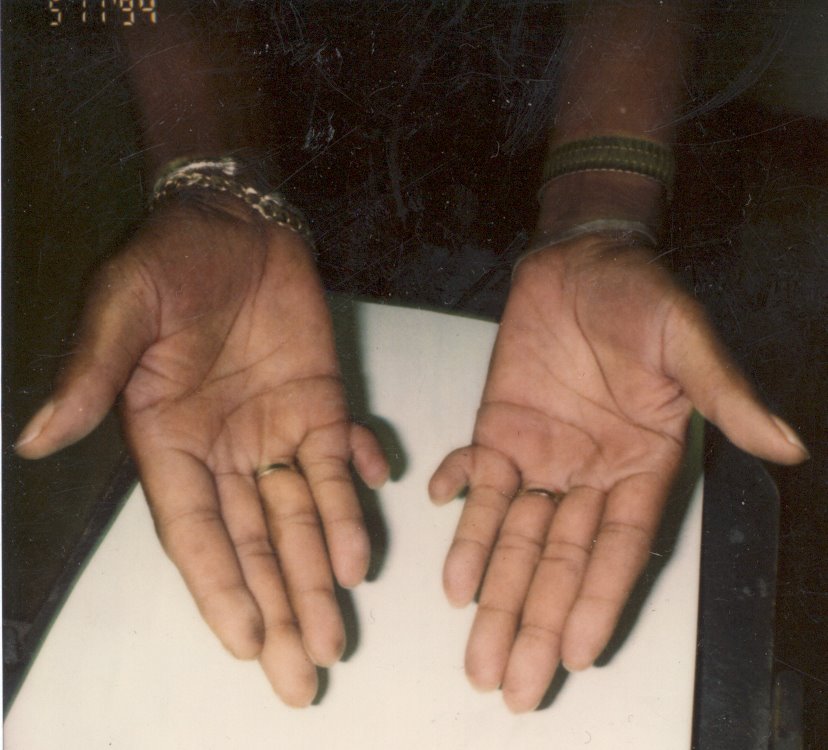
Hand skin's like elephant hide

How big is your hand?

Hello hello hello hello
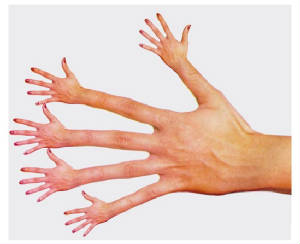
Which one's the little finger?

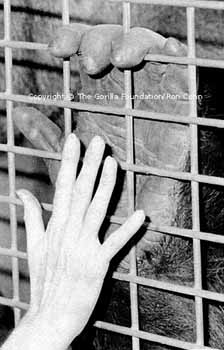
Hello hello hello hello
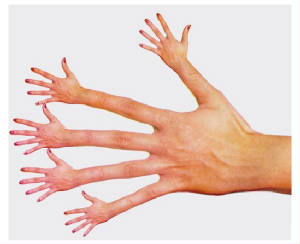
Which one's the little finger?
Tuesday, November 08, 2005
Orangutan paints in free time

Nonja is an orangutan residing at Schoenbrunn Zoo in Vienna. She treads in the footsteps of chimp Conga, a succesful artist who sold paintings at a London auction for £14,400.
Congo, who was born in 1954, produced some 400 drawings and paintings between the ages of two and four.
The previous post in this blog mentioned that Neanderthals have hands as nimble as humans. Well the picture above shows that orangutans have hands nimble enough to handle a paintbrush! We humans aren't so special after all...(or are you an orangutan reading this?)
See also:
Friday, November 04, 2005
Surprising finger facts

- Fingers don't have muscles - fingers are actually moved like puppets on a string, the strings being the tendons which are moved by the muscles of the forearm.
- Most autistic children don't point - so this is used as a diagnostic test for autism. They also tend to have unusually long ring fingers compared to their index fingers.
- Guys usually have longer ring fingers than index fingers, girls vice versa - caused by differences in hormone levels (oestrogen and testosterone), this ratio has been shown to be very significant. It indicates such things as fertility, musical and sports aptitude, health and disease, and recently it was found that it can even show whether you are more likely to have a scientific or a social science brain.
- Index finger best one to lose - although it seems you need this finger more than any other, hand surgeons say that this is the best one to lose (if you had a choice given by terrorists, say). Fingers are most useful working together, and in this case the index finger is needed the least.
- Neanderthals have nimble fingers - contrary to the typical image of Neanderthals as club-wielding, barbaric buffoons, archaeologists have found that they not only had larger brains than us humans, but also that their fingers were just as nimble as ours.
- Fingernails show your state of health - brittle, pale or bluish fingernails are usually bad signs. The nails can indicate problems such as thyroid, anemia, vitamin or mineral deficiencies and liver trouble. Also check horizontal ridges or small indentations - these are indicators of high stress in your recent past - when exactly can be found roughly by checking where on the nail they are (up to a few months ago when close to the tip).
And a BBC radio series that looks at each of the fingers.
Subscribe to:
Posts (Atom)